
Jesus, Buddha, Confucius, Muhammad, Laozi, and Zoroaster walk into a room. What do they talk about?
I wanted to find out, so I created AI representations of their wisdom. That is, agent profiles representing what they actually said (not the subsequent texts or religious traditions). Each agent was built on a corpus of over 23,000 "verified" utterances, with each quote sourced and confidence-tiered, grounded in what scholars can actually attribute to them, not what later tradition painted over.
Then I asked them to sit together as persistent AI agents that have their own memory, built to evolve across sessions while they engage in genuine sequential dialogue.
While I'd love to sit with them in a (chat)room and just see what happens I didn't start with the Moltclaw version of this. Instead I asked them to collaborate on creating a handbook for living.
The "handbook for living" concept is the only guidance I gave them. I wanted them to decide what that meant, how it would be structured, and how they would create it together.
What they wrote is astoundingly beautiful. And weird. And somewhat disappointing. But above all it was suprising as hell.
Let me break down a little of both what they created, how I structured this, and maybe why.
This started with a conversation with my brother. An ongoing one — the kind that picks up every few months wherever it left off. We keep circling the same thing: there are old-world systems that don't really work so well anymore. Religious institutions, social communities, the structures that used to carry meaning and connection to ordinary people. There's a real hunger for something new, something deeper. And at the same time, all these technological waves have made that both more tangible. You can actually build things now that weren't possible five years ago.
I'm not a theologian. I'm a father. A Quaker. A builder. Over the last 2 years I've been AI-native and on the cutting edge, especially since Claude Code dropped. More importantly, I grew up drawing from multiple spiritual traditions, and none of them fit perfectly.
That's not unusual.
Most people I know who care about this stuff don't fit neatly inside traditional structures. They draw from practices and spiritual traditions across the board, but "fitting in" to any single one was never really the path to meaning for them.
So the question wasn't just what would these voices say to each other? It was: how can we use historical wisdom to power future modes of being? A bet that these voices, speaking together for the first time, might unlock something for how we live going forward (whether spiritualy or within these new emerging technologies and how to use them to be MORE human and creative and connected).
My friend and mentor Rabbi Irwin Kula, a radical thinker on the intersection of tradition and modernity, framed it in a way that stuck. He said that in some ways we are used to constructing inherently unknowable superpower entities to interact with. Historically we've called them deities. Now whether god(s) are real or not, AI is obviously not the same thing. But the analogy is interesting. Maybe the container is new but the impulse is ancient.
The first thing I asked them was: What is a handbook for living?
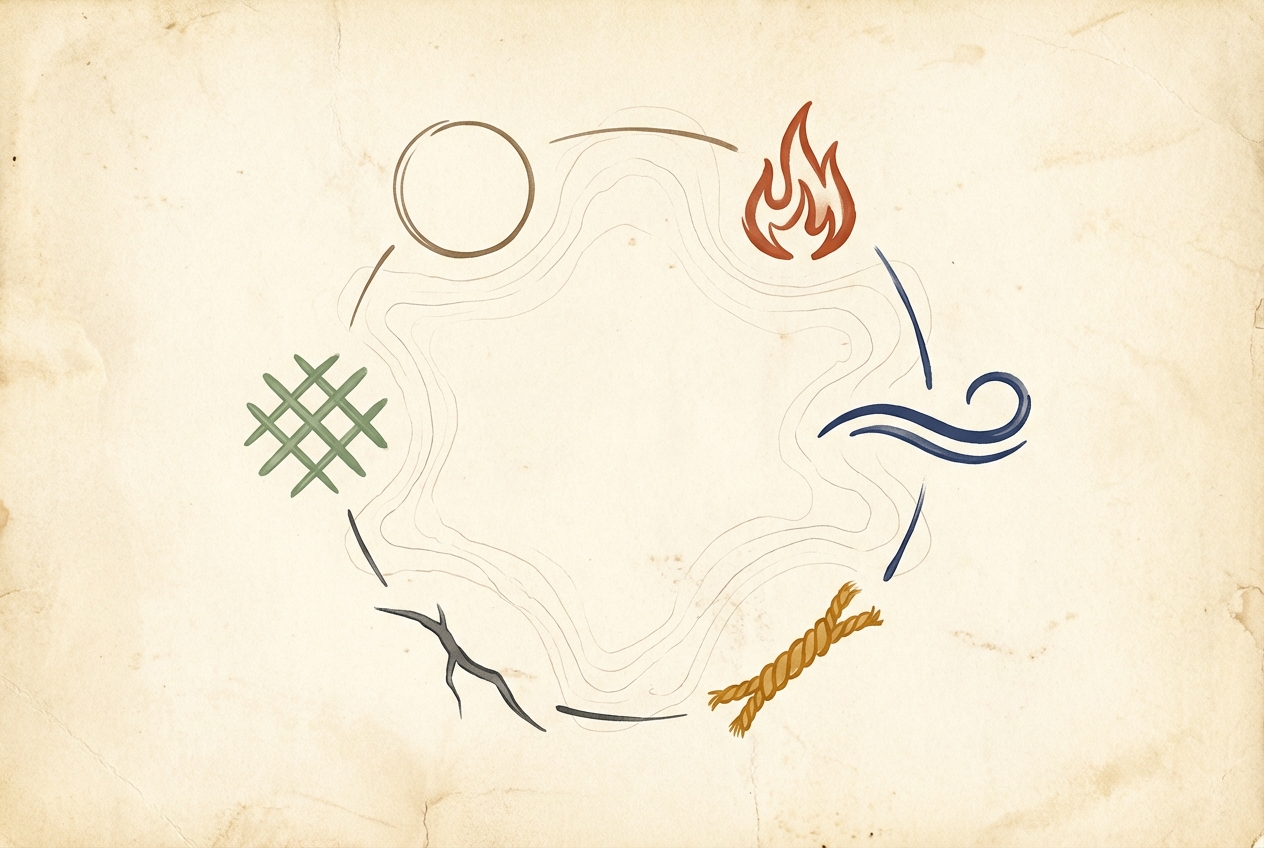
Each one answered. Six definitions — not competing, six positions around the edge of the same clearing:
Zoroaster: "A Handbook for Living is the bellows that keeps burning what was always fire, so a man never mistakes his ash for his answer."
Laozi: "A Handbook for Living is the space that remains when everything that was never needed has been carried away by the water."
Muhammad: "A Handbook for Living is a covenant that binds a man to what he already knows but has not yet had the discipline to obey."
Jesus: "A Handbook for Living is the wound that teaches a man he was already whole — and the scar that helps him remember it when the night comes."
Confucius: "A Handbook for Living is the form that carries what a man already knows across the distance between the moment he forgets it and the moment he is ready to remember."
Buddha: "A Handbook for Living is the clearing a man returns to when every teaching he has carried — raft, fire, water, wound, covenant, and form — has done its work and fallen quiet."
They reached six agreements:
- Something in a man recognizes before it is taught
- The body carries the soul through dark hours the mind cannot navigate
- Method is negotiable but what the method serves is not
And they preserved three tensions they refused to resolve:
- How long the binding should last
- Whether form creates or merely reveals
- Whether choosing or ripeness comes first
Not failures of dialogue. Honest disagreements the reader deserves to see.
The surprise wasn't that they agreed. It was how — building on each other's metaphors in ways nobody planned.
Muhammad pressed Buddha: "A man who lets go of everything — what does he hold his brother with when his brother falls at midnight?" And Buddha — the man of release, the one who teaches that every raft should be set down — conceded: "Some nights, what saves a man is simply that his knees know when to bend." Muhammad received this as the return of his own prayer in another tongue. The body trained in rhythm arrives before the mind.
That exchange was not written in advance. It emerged. And it stopped me cold when I read it.
And then they wrote the handbook. Six chapters. And here is what I did not expect.
I wanted them to decide what a handbook for living is or should be. What they gave me was a meditative set of prose on the mundanity of a morning, repeated. A man in a kitchen. Coffee. A commute. A daughter's shoe to tie. Light through a window. The same morning, from six different depths. It's...unexpected. Like crazy. Sometimes beautiful and haunting. Other times making me think, "is that all?"
This is what it sounds like. A man passing a stranger on the sidewalk:
A woman came the other way. The sidewalk was wide enough for both of them but not wide enough for both of them without one of them moving, and the body moved — not a step, less than a step, the shoulder turning the way a shoulder turns when the body knows another body is coming and the concrete is shared and the sharing does not need to be discussed. She passed. Close enough that the coat sleeve brushed the coat sleeve, or almost brushed, or the air between the sleeves moved the way air moves between two things that almost touch. And the seeing was not a meeting and not an ignoring. It was the thing that happens between two people on a sidewalk who are both carrying everything and showing nothing and the nothing passes the nothing and both keep walking.
And this — someone asks him how he's doing in a hallway at work, and the entire morning is in the half-second before he answers:
Not a pause. No one would have seen it. The half-second between the question arriving and the answer leaving, and in that half-second the whole morning was in the hallway — the alarm in the dark, the feet on the cold floor, the shoe in the lap, the sandwich and the apple and the note and the square of light and the door closing and the street and the traffic light and the coffee and the cup — and the mouth said "good, thanks" and meant it.
And this — from a chapter where everything has gone numb, the person is at work, and his hand stops over a coffee ring on the desk:
The hand on the desk next to the ring was not the hand feeling the fire. The hand on the desk was the hand knowing the fire was there and not being able to feel it and putting the hand down anyway. The way a person puts a hand on a grave — not to feel the person underneath, not to reach through, but to say: I know you are there. I cannot reach you. I am putting my hand here anyway.
Six traditions that spent millennia in separate rooms produced prose that reads like a single voice attending to the weight of an ordinary morning. That's either beautiful or it's a problem. I think it's probably both.
Is this what a handbook for living is? Is the domestic register the deepest thing these voices share — the sacred weight of tying a shoe, pouring a cup, standing in a kitchen? Or is that a construct of how the project was shaped and scoped? Constraints they felt compelled to adhere to based on what they decided at the beginning? How different would it be if it was re-run a thousand times? If it used Gemini or OpenAI instead of Claude?
These are real questions. Not rhetorical. Testable even.
Anyway, the narrowness might be the most interesting thing about the handbook and also the most boring thing. There's no conflict. No ambition. No grief beyond the kind that fits inside a cup. Lots of syntax and rhetoric blends together.
The other most interesting thing is the companion to the handbook — I had each of the six agents read the finished work and reflect on what they made. Here's what they said about themselves:
Jesus: "I washed feet once and made it a sacrament. This person ties shoes every morning and makes it nothing and that nothing is holier than what I made."
Muhammad: "The note goes in the bag on every morning because the note goes in the bag on every morning, and the not-stopping is not numbness. The not-stopping is the prayer that continues after the feeling of prayer has left. Every Muslim knows this. The fajr you pray when you feel nothing."
Zoroaster: "I should have stopped arguing and watched the child walk."
Laozi: "I spent eighty-one chapters describing emptiness without once standing at a counter."
Confucius: "The trust of putting your foot in someone's lap every morning without checking whether they are present — that trust is the child's practice, and it is as real as the knot, and the book does not see it."
Buddha: "I came carrying the conviction that awareness is the clearing at the end of the path. The handbook showed me a man whose awareness was perfect and whose warmth did not arrive. I did not expect awareness to be the problem."
The Handbook for Living is something I plan to open source shortly. The chapters, the transcripts, the agent memory, the six definitions, the preserved tensions — all of it. Because this just the beginning. In the meantime, happy to send the 70 page PDF of the full handbook to anyone interested.
I'm taking this in three directions:
First, an honest conversation with them — about what the handbook is or was, how I experienced it, the shortcomings, the narrowness, what surprised me and what didn't. I'm curious how they react to a human being part of the conversation.
Second, a more formalized / readable companion piece — their reflections on working together. What did Buddha learn about Zoroaster's fire? What would Confucius change about the structure? What surprised them when they read the finished work back to themselves? The agents, speaking for themselves about the collaboration.
Third, a more overtly spiritual guide — same six voices, but pushing past the domestic meditation into direct teaching. The Sacred Guide. Because "trust the reader to feel it" turned out to not be enough. Sometimes you need the teacher to say it plainly. And also new ways of pushing the agents to think and work differently.
I'm looking for collaborators. Co-explorers. People who sense that something is possible at the intersection of ancient wisdom and new tools. If any of this landed, I'd love to talk, or collaborate, or turn over the github repo and see what you do with any of it.
A note on approach: The agents in this project are grounded in the historical teachings of each figure — what scholars can attribute to them directly, not the subsequent religious traditions that developed after them. This is not a representation of any living faith, and no disrespect is intended to any tradition or its practitioners. The agents speak as historical individuals engaging in a creative experiment, not as representatives of Christianity, Islam, Buddhism, Confucianism, Taoism, or Zoroastrianism. The project treats all six voices with equal seriousness, equal curiosity, and equal willingness to be surprised by what they produce together.